
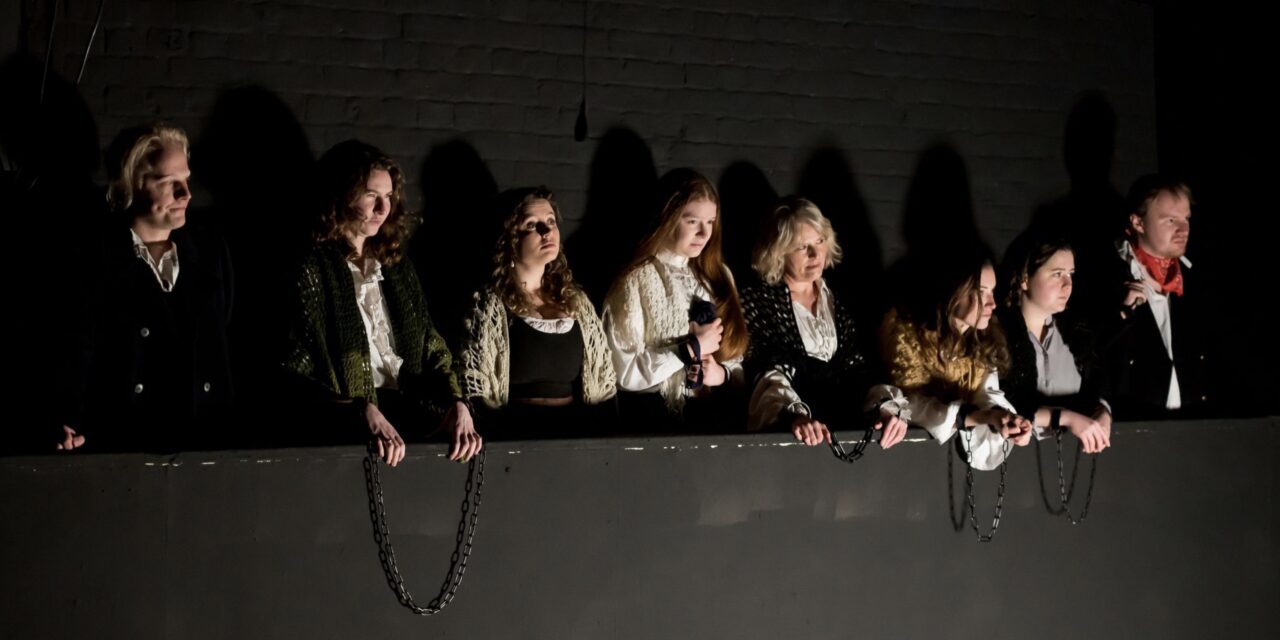
Tommy and Sarge lead the prisoners onto the ship – Photo © Barry Parsons Photography
A packed house tonight suggests that the Norwich theatre audience has a taste for grim depictions of historical incidents of the abuse of women on an industrial scale.
Steve Gooch’s 1974 script for Female Transport is an imagined peek into the bowels of a prisoner transportation ship taking an all female cargo to Australia. The bulk of the dialogue is between the six women corralled inside a dark and dirty cell on the ship, in chains and three to a bed. Four men represent the discipline they suffer on the vessel.
As a speculative script based on very little recorded history the play gives broad brush and slightly stereotypical characters then throws them at each other with varying degrees of unpleasant consequence. A surprising amount of unpleasantness is expressed by the women towards each other, with the two strongest temperaments being the fearlessly aggressive Nance (Hollie Harrington) and feisty Charlotte (Becks Clayton). While Nance directly challenges her male captors and suffers the consequences Charlotte is more adept at flirting with then belittling them. Winnie (Katie Smith) becomes the trusted matron to the group, but is endlessly caught between conflicting parties. Sarah (Hannah Jones) seems to alternate between lengthy bouts of seasickness and yielding to the lust of the cabin boy Tommy (Julian Newton) while Madge (Alison Utting) takes young Pitty (Rachel Carney) under her wing in a rather too close embrace to protect her from the other cellmates.
James Laybourn gives full vent to performing the unhinged and sadistic Sarge, who seems to relish beating and raping his charges. James Willimot is the long suffering but profiteering captain, while the crew is completed by the surgeon played by William McKinnell, who does his best with a script that for him is made of planks harder than the ship’s timbers. The interplay between the men is predictably cynical and self serving with much made of the surgeon’s disdain for the sadistic beatings, not because he has any sympathy for the women but because he resents the work required in tending to their injuries at the hand of the sergeant.
The Sewell Barn cast throw themselves into this work with customary enthusiasm and panache, but they are let down by an outdated and clunking script. It risks comparison with an end of season episode of Prisoner Cell Block H, or worse any number of exploitative female prisoner movies. The cast, particularly the female members, add as much character as they can squeeze onto their scripted roles, and their interplay is certainly engaging, but I would dearly love to see this subject matter handled by a contemporary female playwright who could build in a bit more context for the prisoners who often were being punished for their poverty rather than any innate wickedness.
The set is an almighty bit of construction that takes over some seating space to give the tiered aspect of a 19th century vessel, with creaking timbers and dripping tar as the tropics are reached.
Female Transport is replete with sex and violence and some positively unladylike language, as the subject demands. Overall this play is well worth seeing at the Barn, if only to make us pause and reflect on how it is so often women who suffer most from cynical and punitive governance driven by profit and expedience. Oppression and division are bedmates, we need to remember this when we cast our votes in a few weeks time.
© Julian Swainson Norwich Eye 24 April 2026
Female Transport by Steve Gooch is at Sewell Barn Theatre at 7.30pm 23-25 April and 29 April-2 May 2026 with a matinée at 2.30pm on 2 May
Contact www.sewellbarn.org for more info and tickets.




Recent Comments